
Blog
E-Bike Weight Guide: How Heavy Is Too Heavy?

An e-bike weight guide becomes useful the moment a promising bike has to leave the road. A machine that feels lively under motor assistance can feel very different when it must be carried up six steps, turned through a narrow hallway, lifted onto a car rack, or steadied on a crowded railway platform.
That is why the best weight is not simply the lowest number on a specification sheet. It is the weight that fits the awkward parts of your real routine. A rider with a ground-floor garage may happily choose a solid 29 kg folding model, while someone living on the third floor without a lift may find even 23 kg inconvenient after a long commute.
This guide explains how to judge e-bike weight in kilograms, how bike weight differs from payload capacity, and which practical checks matter before buying. The aim is not to declare one universal cut-off. It is to prevent a manageable daily ride from becoming a weekly lifting problem.
Why E-Bike Weight Matters Away From the Saddle
Motor assistance disguises mass once the bike is moving. At a traffic light, on a moderate climb, or along a cycle lane, the motor helps overcome some of the effort that would make a conventional heavy bicycle tiring. The motor does not help when the bike is switched off and being pushed backwards, lifted over a threshold, balanced on one wheel in a lift, or raised to rack height.
| Daily situation | Why weight matters | Question to answer before buying |
|---|---|---|
| Apartment stairs | You carry the bike’s full mass while managing pedals, handlebars and doors | How many steps can you manage after a tiring ride? |
| Train travel | Platforms, lifts, bicycle hooks and quick connections can require controlled handling | Does the operator accept the bike’s size and weight? |
| Car transport | The rack has total and per-bike limits, and the lift height may be awkward | Can both you and the rack safely handle the complete bike? |
| Indoor storage | A heavier bike is harder to pivot around furniture or stand vertically | Can it roll all the way to its parking space? |
| Puncture or flat battery | You may need to push an unassisted bike farther than expected | Can you comfortably walk it up your steepest regular section? |
Weight also interacts with cost, equipment and durability. A larger battery, suspension fork, wide tyres, racks and stronger frame members add mass, but they may deliver benefits you genuinely need. The useful comparison is therefore not “light versus heavy” in isolation. It is “necessary equipment versus weight you will have to manage.” Our three-year ownership cost guide takes a similar whole-life approach to budgeting rather than looking only at the purchase price.
There Is No Single Number That Makes an E-Bike Too Heavy
As a planning shortcut, many shoppers can treat roughly 20 kg as relatively manageable for a full-size electric commuter, the mid-20 kg range as something that deserves a real lifting test, and about 29 kg or more as a bike that benefits from roll-in storage and a low-loading transport plan. These are not quality grades and they are not safety limits. Rider strength, grip, height, injuries, stair shape and bike geometry can change the experience completely.
A well-balanced 25 kg bike can be easier to push than a lighter model with a rear-heavy battery. A step-through frame may be convenient to ride but may offer fewer comfortable places to grab when lifting. A folding hinge reduces stored size, yet wide tyres and a large battery can make a folding e-bike heavier than a slim full-size city bike. Always separate three questions:
- Can I ride this bike comfortably?
- Can I control it at walking speed with the motor off?
- Can I move and store it on the hardest day of my normal week?
Start With Your Route, Not the Specification Table
Count every unavoidable lift
Walk from the street to the place where the bike will actually sleep. Count steps, raised thresholds and tight turns. Check whether a lift is deep enough for the full wheelbase and whether handlebars can turn without trapping your fingers. If the battery is removable, find out whether removing it makes the lift meaningfully easier and whether you have a safe place to put it while moving the bike.
Then repeat the route mentally with shopping bags, rain gear or a child waiting nearby. A lift that feels acceptable during a calm showroom visit can become inconvenient when it is repeated twice a day. If stairs are unavoidable, a lighter conventional-frame commuter may be more useful than a feature-rich bike whose extra equipment stays in the storage room.
Plan for pushing as well as riding
Consider station ramps, pedestrian bridges, underground parking exits and the final slope to your building. Walk assist can help on some bikes, but it should not be the only thing making the route possible. Controls vary, batteries can be empty, and there are places where precise manual control matters more than powered movement.
Extra mass can also affect energy use. BikeRadar’s e-bike range guidance explains that rider effort, terrain, assistance level, and carrying luggage all change the load placed on the battery. That does not mean a light bike automatically travels farther: battery capacity, tyre pressure, temperature, stops, and riding style also matter. It does mean that a quoted range should not be read without considering the rider, bicycle, and luggage together. See our guide to e-bike range claims for a fuller explanation.

Bike Weight and Maximum Payload Are Different Numbers
Bike weight normally describes the bicycle itself, although brands do not always measure it the same way. One figure may include the battery, pedals, lights and racks; another may omit accessories. Package weight is different again because it includes the carton and protective materials. When two models appear unusually far apart, check exactly what the published number includes.
Maximum payload or load capacity usually concerns how much the bicycle is designed to carry. Depending on the maker, that may include the rider, luggage, child seat and accessories, while some documentation instead gives a maximum permissible total weight. Do not subtract or combine figures until the manufacturer’s definition is clear. If you plan to carry a passenger, child seat or heavy cargo, confirm that the frame, rack and accessory are all approved for that use.
For a practical estimate, add the rider’s riding weight, lock, panniers, laptop, groceries, water and any permanently fitted accessories. Leave a margin rather than planning to sit exactly on a published limit. The bicycle’s own weight still matters for lifting and transport even when the payload calculation is comfortably within bounds.
Check Trains and Car Racks Before Checkout
European rail access is not identical across operators. The EU’s rail passenger rights information notes that companies may apply operational restrictions based on a bicycle’s weight and dimensions, so the operator’s current conditions should be checked for the exact journey. Deutsche Bahn, for example, explains in its bicycle travel guidance which pedelecs are accepted, when reservations are needed, and how folded bicycles may be treated as luggage when safely stowed.
For a car rack, do not look only at the rack’s total capacity. Check the maximum allowed for each rail or bicycle position, the vehicle’s relevant load limit, tyre width, wheelbase and clamping compatibility. Thule’s current bike-carrier safety guidance says not to exceed either the carrier’s maximum load or the specified maximum weight per bike. Removing a battery before lifting can reduce the load in your hands, but it does not make an unsuitable rack suitable; follow the bike and rack manufacturers’ instructions.
Test the Awkward Movements Before You Buy
A short ride is not enough. If a test bike is available, switch the assistance off and try the movements that mirror your home routine, with staff permission:
- Walk the bike slowly, turn it in a narrow space and reverse it through a doorway.
- Lift each end just high enough to clear a threshold.
- Find a secure lifting point that does not pinch cables or controls.
- Hold the bike on a modest ramp and restart without rolling backwards.
- Fold and unfold it if applicable, then carry it a few controlled steps.
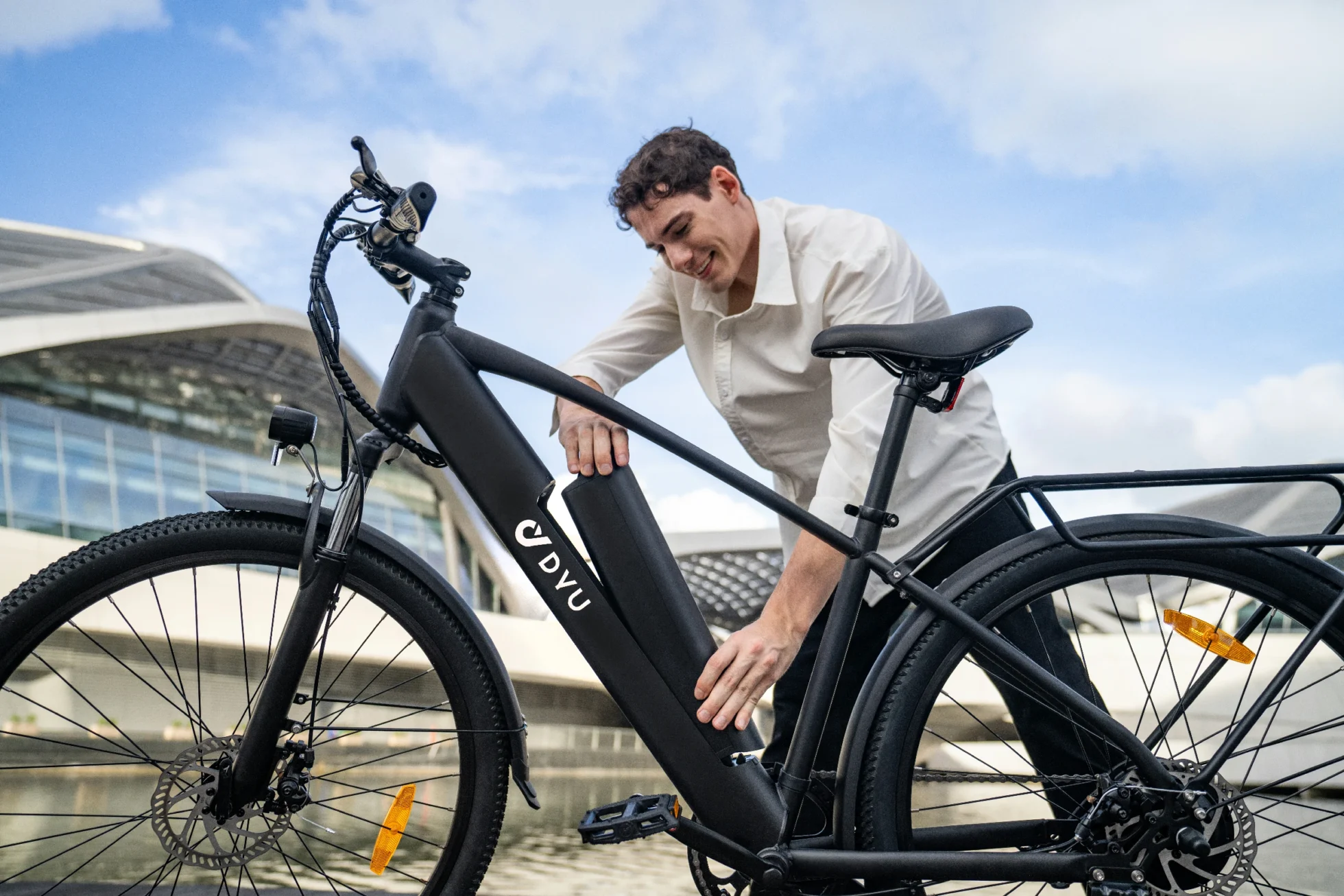
- Check whether the battery can be removed without first taking the bike outside.
If buying online, measure your storage route and use a suitcase or safely packed object to simulate the listed mass. The shape will not match a bike, but the exercise can reveal whether the number is already beyond a comfortable lift. Also read the delivery and assembly information before the box arrives; our delivery and first-ride checklist covers the checks to make before riding.
Three Current E-Bike Weight Examples
The following examples show why weight should be matched to a use case rather than ranked on its own. Prices and availability were checked on 22 July 2026. Weight figures come from the manufacturers’ current product information; specifications can change, so confirm them again before ordering.
| Model | Listed bike weight | Current price | Useful context |
|---|---|---|---|
| HITWAY BK18 Pro | 20.5 kg | €1,149.99 | A relatively light full-size step-through commuter with a belt drive; appealing when stairs and frequent handling matter. The official BK18 Pro page supports the weight figure. |
| HITWAY BK32 | 25 kg with battery | €1,249.99 | A step-through mid-drive example that adds more mass than the BK18 Pro but may suit riders prioritising mid-drive assistance and easy mounting. See the official BK32 specification. |
| HITWAY BK6S L1 | 29 kg | €899.99 | A folding 20-inch model whose compact stored shape does not make it especially light; best considered where it can be rolled close to a car or storage space. The official BK6S L1 page lists its net weight. |
The 8.5 kg spread between these examples is noticeable, but it does not create an automatic winner. The 20.5 kg bike may be the sensible choice for an upstairs flat. The 25 kg mid-drive may be the better match for a rider who can use a lift and values its assistance layout. The 29 kg folder may still be practical for ground-floor storage and car trips where folded dimensions matter more than carrying it far.
A Simple Pre-Purchase Weight Checklist
- Record the complete bike weight and whether it includes the battery and standard accessories.
- Measure every doorway, lift, stair turn and storage gap on the daily route.
- Check whether the battery can be removed before lifting and how much that changes the carried mass.
- Confirm the bicycle’s payload definition and add rider, luggage and accessories realistically.
- Check train operator, car rack and vehicle limits for the exact journey or setup.
- Test walking, reversing, threshold lifting and parking with the motor off.
- Choose the lightest bike that still provides the battery, comfort, braking and cargo features you genuinely need.
Final Advice
An e-bike is too heavy when its non-riding moments stop fitting your life. Start with the stairs, storage and transport that cannot be avoided, then evaluate whether each kilogram buys a feature you will use. A heavier bike can be an excellent commuter when it rolls from a secure ground-floor space. A lighter model can be worth paying more for when it must be carried every day.
Do not let strong motor numbers hide a difficult ownership routine. Verify the complete weight, simulate the hardest lift, check transport rules and leave a realistic payload margin. Those few checks are more valuable than chasing the lowest number or assuming every folding bike will be easy to carry.
FAQs
Q1. Is a 25 kg e-bike too heavy for commuting?
Not automatically. A 25 kg bike can be practical with ground-floor storage, a suitable lift and mostly rideable routes. It may be inconvenient if you must carry it up several flights, lift it onto a high rack or make fast train changes. Test the hardest off-bike movement, not only the ride.
Q2. Can I carry an e-bike upstairs every day?
Some riders can, but the answer depends on bike balance, secure handholds, stair width, personal strength and injury history. Remove the battery only if the manufacturer permits it and you can handle both parts safely. If daily carrying feels marginal during a calm test, it is unlikely to improve when you are tired or the stairs are wet.
Q3. Does a heavier e-bike always have less range?
No. Total mass can affect energy use, but battery capacity, assistance level, terrain, tyre pressure, temperature, stops and riding style also influence range. Compare the whole system and treat advertised range as a conditional estimate rather than a guaranteed distance.
Q4. Are folding e-bikes lighter than full-size e-bikes?
Not necessarily. Folding describes how the frame reduces its stored size, not how much it weighs. Hinges, wide tyres, suspension and large batteries can make a folder heavier than a slim full-size commuter. Check both net weight and folded dimensions.
Q5. What e-bike weight is suitable for a car rack or train?
There is no universal figure. Use the rack’s total and per-bike limits, the vehicle limit, and the rail operator’s current size, weight, reservation and storage rules. Confirm compatibility for the exact bike rather than assuming that all products advertised for e-bikes or bicycles accept every model.


